

Search results in Conference/School from PIRSA
Format results
-
Talk
-
Opening Remarks
-
Marcela Carena Perimeter Institute for Theoretical Physics
-
Emily Petroff Perimeter Institute for Theoretical Physics
-
Chris Waddell Perimeter Institute for Theoretical Physics
-
-
-
Chaos and the Emergence of the Cosmological Horizon
David Kolchmeyer Massachusetts Institute of Technology
-
Operator Algebras and Third Quantization
Nima Lashkari Purdue University West Lafayette
-
Swing Surfaces in AdS/CFT
Sabrina Pasterski Perimeter Institute for Theoretical Physics
-
An Emergent Area Operator in 2d CFT
Ronak Soni Chennai Mathematical Institute
-
Gravity As An Oracle (Vision Talk)
Raphael Bousso University of California, Berkeley
-
Vacuogenesis (Vision Talk)
Ted Jacobson University of Maryland, College Park
-
-
Talk
-
Opening Remarks
-
Marcela Carena Perimeter Institute for Theoretical Physics
- Laurent Freidel
PIRSA:25060029 -
-
-
-
-
-
-
Gravitational collapse, shock waves and white holes
Viqar Husain University of New Brunswick
PIRSA:25060035 -
Building and (hints of) seeing gravitational statistical mechanics
Seth Major Hamilton College
PIRSA:25060036
-
-
Talk
-
-
Causal Inference Meets Quantum Physics
Robert Spekkens Perimeter Institute for Theoretical Physics
PIRSA:25040086 -
Creativity by Compositionality in Generative Diffusion Models
Alessandro Favero École Polytechnique Fédérale de Lausanne
PIRSA:25040088 -
Towards a “Theoretical Minimum” for Physicists in AI
Yonatan Kahn Princeton University
PIRSA:25040089 -
Solvable models of scaling and emergence in deep learning
Cengiz Pehlevan Harvard University
PIRSA:25040091 -
Architectural bias in a transport-based generative model : an asymptotic perspective
Hugo Cui Harvard University
PIRSA:25040092 -
Statistical physics of learning with two-layer neural networks
Bruno Loureiro École Normale Supérieure - PSL
PIRSA:25040093 -
Renormalization Group Flows: from Optimal Transport to Diffusion Models
Jordan Cotler Harvard University
PIRSA:25040095
-
-
Talk
-
Panel Discussion
-
Shirley Ho Flatiron Institute
-
Vicky Kalogera Northwestern University
-
Roger Melko University of Waterloo
-
Jesse Thaler Massachusetts Institute of Technology (MIT)
-
Marcela Carena Perimeter Institute for Theoretical Physics
PIRSA:25040079 -
-
-
Opening Remarks
PIRSA:25040109 -
EAIRA: Establishing a methodology to evaluate LLMs as research assistants.
Frank Cappello Argonne National Laboratory
PIRSA:25040059 -
State of AI Reasoning for Theoretical Physics - Insights from the TPBench Project
Moritz Munchmeyer University of Wisconsin–Madison
PIRSA:25040061 -
UniverseTBD: Democratising Science with AI & Why Stories Matter
Ioana Ciuca Stanford University
PIRSA:25040062 -
-
-
-
Talk
-
-
Snap, Crackle and Pop
Roger Blandford Roger Blandford
-
-
Black Hole Jet Sheath as a Candidate for the Comptonizing Corona
Navin Sridhar Stanford University
-
-
Workshop Talk
Luciano Combi Perimeter Institute for Theoretical Physics
-
Rethinking The Black Hole Corona as an Extended, Multizone Outflow
Lia Hankla University of Maryland, College Park
-
Quantifying flux rope characteristics in relativistic 3D reconnection simulations
Jesse Vos Katholieke Universiteit Leuven
PIRSA:25030133
-
-
Talk
-
Quantum Spacetime: from Speculation to Numbers
Renate Loll Radboud Universiteit Nijmegen
-
Quantum Gravity through the lens of Effective Field Theory
Alessia Platania University of Copenhagen
-
Planck-scale violations of relativistic symmetries in astrophysics and in quantum systems
Giulia Gubitosi University of Naples Federico II
PIRSA:25030057 -
Quantum Dynamics of Causal Sets: Results and Challenges
Sumati Surya Raman Research Institute
-
Ensembles of open quantum systems as a tool for quantum spacetime
Sarah Shandera Pennsylvania State University
-
Exploring the expanding Universe with the Dark Energy Survey
Jessica Muir University of Cincinnati
-
Gravitational waves as a window on gravity
Jocelyn Read California State University, Fullerton
-
Quantum Gravity in the era of Gravitational-Wave astronomy
Mairi Sakellariadou King's College London
-
-
Talk
-
-
Intensity correlations: imaging and quantum optics in astrophysics
Robin Kaiser The French National Centre for Scientific Research
-
Intensity Interferometry with the H.E.S.S. telescopes
Naomi Vogel ECAP, FAU Erlangen-Nürnberg
-
Progress Toward Multi-Channel Intensity Interferometry with the Southern Connecticut Stellar Interferometer
Elliott Horch Southern Connecticut State University
-
-
The Multi Aperture Spectroscopic Telescope: Status and potential as an intensity interferometry facility
Sagi Ben Ami Weizmann Institute of Science
-
-
Future Astrophysical Targets for Intensity Interferometry
Norman Murray Canadian Institute for Theoretical Astrophysics (CITA)
-
-
Talk
-
Opening Remarks
-
Sonya Gzyl Max Planck Institute of Quantum Optics
-
Timothy Hsieh Perimeter Institute for Theoretical Physics
-
-
-
-
Towards large-scale quantum simulations with trapped ions - Rajibul Islam
Kazi-Rajibul Islam Institute for Quantum Computing (IQC)
-
-
-
-
-
-
Talk
-
-
Tutorial: Causal Inference Meets Quantum Physics
Robert Spekkens Perimeter Institute for Theoretical Physics
-
Counterfactual and Graphical Frameworks for Causal Modeling
Thomas Richardson University of Washington
-
-
Modeling Latent Selection with Structural Causal Models
Leihao Chen University of Amsterdam, Korteweg-de Vries Institute for Mathematics
-
Relating Wigner's Friend Scenarios to Nonclassical Causal Compatibility, Monogamy Relations, and Fine Tuning
Yìlè Yīng Perimeter Institute for Theoretical Physics
-
Zero Inflation as a Missing Data Problem: a Proxy-based Approach
Trung Phung Johns Hopkins Whiting School of Engineering
-
-
-
Talk
-
Everything that can be learned about a causal structure with latent variables by observational and interventional probing schemes
Marina Maciel Ansanelli Perimeter Institute for Theoretical Physics
PIRSA:24090191 -
-
-
-
The g-function and defect changing operators from wavefunction overlap on a fuzzy sphere
Zheng Zhou Perimeter Institute for Theoretical Physics
PIRSA:24090190 -
Open Quantum On Lie Group: An Effective Field Theory Approach
Afshin Besharat University of Alberta
PIRSA:24090192 -
Photon Rings and Shadow Size for General Integrable Spacetimes
Kiana Salehi perimeter institute and university of Waterloo
PIRSA:24090193 -
-
-
Talk
-
Lecture - Celestial Holography Ia
PIRSA:24070002 -
Lecture - Canonical a
PIRSA:24070003 -
Lecture - Celestial Holography Ib
PIRSA:24070004 -
Lecture - Amplitudes a
PIRSA:24070005 -
Vision Talk
PIRSA:24070006 -
Lecture - Celestial Holography IIa
PIRSA:24070007 -
Lecture - Canonical b
PIRSA:24070008 -
Lecture - Celestial Holography IIb
PIRSA:24070009
-
-
Talk
-
-
-
Horndeski Gravity in Cosmology
Alessandra Silvestri Leiden University
-
How we rediscovered Horndeski gravity
Cedric Deffayet Institut d'Astrophysique de Paris
-
Black holes in Horndeski theories
Christos Charmousis The French National Centre for Scientific Research
-
Hi-COLA: Horndeski Goes Non-linear
Tessa Baker University of Portsmouth
-
Photon Rings and Shadow Size for General Axi-Symmetric and Stationary Integrable spacetimes
Kiana Salehi perimeter institute and university of Waterloo
PIRSA:24070086 -
Modified gravity getting to the one-point clustering statistics
Cora Uhlemann Bielefeld University
PIRSA:24070087
-
-
QIQG 2025
QIQG 2025: Quantum Information in Quantum Gravity
QIQG 2025: Quantum Information In Quantum Gravity will unite researchers working at the intersection of quantum information theory and quantum gravity, to exchange insights and showcase recent developments bridging these fields. As part of the celebrations of Perimeter’s 25th anniversary, we will also feature vision talks by world-leading experts exploring pivotal and emerging themes at the nexus of quantum information and quantum gravity. Our program will span topics such as:- Algebraic approaches to field theory and gravity
- Observers, quantum reference frames, and relational observables
- Quantum focussing and the Generalized Second Law
- SYK and its double-scaled limit
- The quantum information theoretic structure of spacetime
- Edge modes and entanglement entropy across subregions
- The role of complexity in field theory and gravity
- The black-hole information puzzle and related issues
- Quantum error-correcting codes in quantum field theory and quantum gravity
- Quantum cryptography and its implications for gravity
- Gravitational wormholes and their information-theoretic implications
- Chaos and thermalization in many-body systems and their realization in quantum gravity
- Holographic cosmology and de Sitter space
:: :: ::
Scientific Organizers
Luca Ciambelli (Perimeter Institute)
Rob Myers (Perimeter Institute)
Chris Waddell (Perimeter Institute)
Beni Yoshida (Perimeter Institute)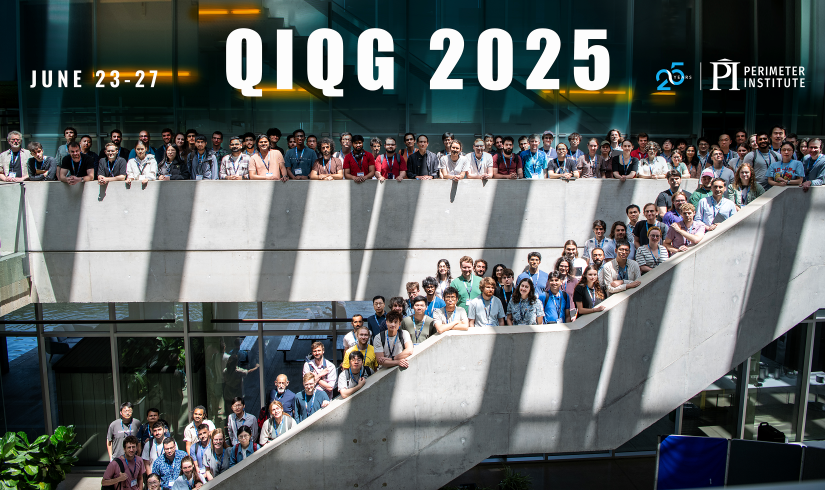
-
Lee's Fest: Quantum Gravity and the Nature of Time
What is time? Is it fundamental or emergent? This question lies at the foundation of contemporary physics and provides a key to unlocking some of its most challenging open problems, from quantum gravity to cosmology. The quest to understand time extends beyond the realm of physics, providing a privileged standpoint to address questions in diverse fields such as philosophy, mathematics, and computer science.
In this conference, we explore the nature of time from many different perspectives. This is the occasion to honor Perimeter’s “Master of Time,” Lee Smolin, and to celebrate his seminal scientific contributions. Lee Smolin is a founding faculty member of Perimeter Institute and a primary inspiration behind its spirit and design. This is an opportunity to journey back in time to the origins of some of the groundbreaking initiatives that Lee helped develop, and to look forward to future developments inspired by his achievements. The conference focuses on time but also on the foundations of quantum mechanics and the quest for quantum gravity, particularly Loop Quantum Gravity, of which Lee Smolin is a co-creator. In the spirit of Lee Smolin, the conference celebrates the interdisciplinary nature of the journey toward quantum gravity, with contributions from physics, mathematics, computer science, and philosophy.
:: :: ::
Scientific Organizers
Laurent Freidel (Perimeter Institute)
Maïté Dupuis (Perimeter Institute)
Dongxue Qu (Perimeter Institute)
Francesca Vidotto (Western University):: :: ::
Speakers
- Niayesh Afshordi (University of Waterloo)
- Stephon Alexander (Brown University)
- Giovanni Amelino-Camelia (University of Naples Federico II)
- Julian Barbour (Independent)
- Bianca Dittrich (Perimeter Institute)
- Fay Dowker (Imperial College)
- Avshalom Elitzur (Chapman University)
- Lucien Hardy (Perimeter Institute)
- Viqar Husain (University of New Brunswick)
- Jenann Ismael (Johns Hopkins University)
- Ted Jacobson (Maryland University)
- Jaron Lanier (Microsoft Research)
- Etera Livine (Lyon, Ecole Normale Superieure)
- João Magueijo (Imperial College London)
- Seth Major (Hamilton College)
- Carlo Rovelli (Aix-Marseille University)
- Simon Saunders (Oxford University)
- Simone Speziale (Aix-Marseille University)
- Francesca Vidotto (Western University)
- Steven Weinstein (University of Waterloo)
:: :: ::
Credit: Artwork by Kaća Bradonjić -
Theory + AI Workshop: Theoretical Physics for AI
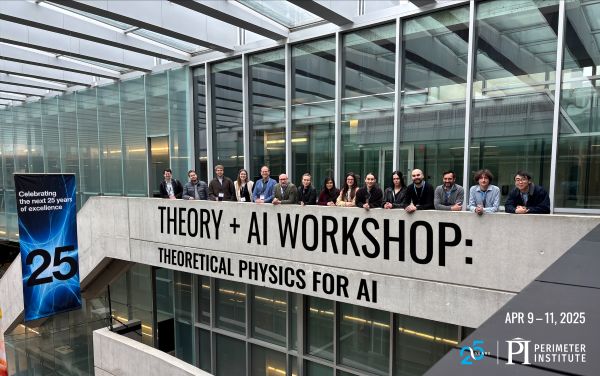
 This 5-day program will explore the intersection of AI and fundamental theoretical physics. The event will feature two components, a symposium and a workshop, centered around two complementary themes: AI for theoretical physics and theoretical physics for AI.
The program will begin on April 7 and 8 with a large symposium with speakers and panel discussions focusing on the promise of AI to accelerate progress in theoretical physics. These talks will address the possibilities and challenges associated with AI ‘doing science.’ The event will bring together physicists, engineers, AI researchers, and entrepreneurs to collect different perspectives on what the future of theoretical physics will look like, the engineering challenges we should expect along the way, what tools and collaborations will be needed to help get us there, and what exciting steps are already underway.
Registration for the symposium is available on the symposium website.
The symposium will be followed by a workshop on April 9, 10, 11 focusing on developing a theoretical framework for AI enabling the development of reliable, robust, and interpretable AI models for physics. Recent advances in theoretical foundations of AI, inspired by techniques from string theory, quantum field theory (QFT), and statistical physics, have uncovered parallels between AI systems and physical theories, utilizing methods like renormalization group (RG) flows, Feynman path integrals etc. to deepen understanding of deep neural networks (DNNs), generative AI (e.g., LLMs and diffusion models), and scaling laws. Key topics include physics-informed optimization and learning, the role of RG and QFT for DNNs and generative AI, and the application of physics to AI interpretability. Through interdisciplinary dialogue, the event aims to foster collaborations, advance the theoretical foundations of AI, and explore its potential in areas like theoretical physics and mathematics. Speakers:- David Berman (Queen Mary University of London)
- Blake Bordelon (Harvard University)
- Jordan Cotler (Harvard University)
- Hugo Cui (Harvard University)
- Alessandro Favero (EPFL)
- Ro Jefferson (Utrecht University)
- Yonatan Kahn (University of Toronto)
- Dmitry Krotov (IBM)
- Bruno Loureiro (École Normale Supérieure in Paris)
- Luisa Lucie-Smith (The University of Hamburg)
- Cengiz Pehlevan (Harvard University)
- Rob Spekkens (Perimeter Institute)
Scientific Organizers:
- Anindita Maiti (Perimeter Institute)
- Matt Johnson (Perimeter Institute)
- Sabrina Pasterski (Perimeter Institute)
Advisory Committee:
- Achim Kempf (University of Waterloo)
- Cengiz Pehlevan (Harvard University)
- Hiranya Peiris (University of Cambridge)
- Roger Melko (University of Waterloo)
-
Theory + AI Symposium
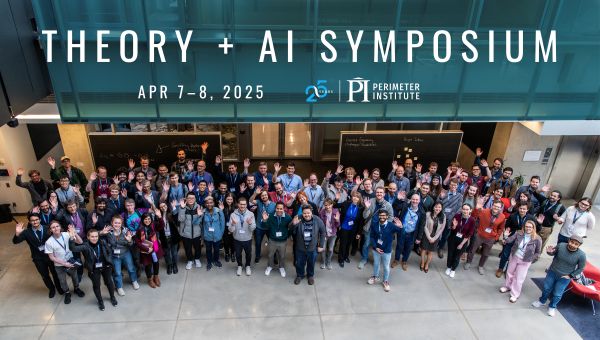
 As Perimeter enters its 25th year, we invite you to imagine what theoretical physics research will look like 25 years from now. On April 7 and 8, Perimeter will be hosting a symposium with speakers and panel discussions focusing on the promise of AI to accelerate progress in theoretical physics. These talks will address the possibilities and challenges associated with AI ‘doing science.’ The event will bring together physicists, engineers, AI researchers, and entrepreneurs to collect different perspectives on what the future of theoretical physics will look like, the engineering challenges we should expect along the way, what tools and collaborations will be needed to help get us there, and what exciting steps are already underway.
Confirmed Speakers:
As Perimeter enters its 25th year, we invite you to imagine what theoretical physics research will look like 25 years from now. On April 7 and 8, Perimeter will be hosting a symposium with speakers and panel discussions focusing on the promise of AI to accelerate progress in theoretical physics. These talks will address the possibilities and challenges associated with AI ‘doing science.’ The event will bring together physicists, engineers, AI researchers, and entrepreneurs to collect different perspectives on what the future of theoretical physics will look like, the engineering challenges we should expect along the way, what tools and collaborations will be needed to help get us there, and what exciting steps are already underway.
Confirmed Speakers:
-
Frank Cappello (Argonne National Laboratory)
-
Yuri Chervonyi (Deep Mind)
-
Ioana Ciuca (Stanford University)
-
Deyan Ginev (LaTeXML)
- Geoffrey Hinton (University of Toronto)
- Shirley Ho (Polymathic & Simons Foundation)
-
Vicky Kalogera (Northwestern University)
-
Jared Kaplan* (Anthropic)
-
Peter Koepke (University of Bonn)
-
Roger Melko (University of Waterloo)
-
Moritz Munchmeyer (University of Wisconsin–Madison)
-
Axton Pitt (Litmaps)
-
Xiaoliang Qi (Stanford University)
-
Oleg Ruchayskiy (Niels Bohr Institute)
-
Gaurav Sahu (MILA)
-
Steinn Sigurdsson (arXiv)
-
Jesse Thaler (Massachusetts Institute of Technology)
-
Stephen Wolfram* (Wolfram Research)
-
Richard Zanibbi (Rochester Institute of Technology)
*virtual presentation
Scientific Organizers:-
Matthew Johnson (Perimeter Institute)
-
Anindita Maiti (Perimeter Institute)
-
Sabrina Pasterski (Perimeter Institute)
Advisory Committee:- Mykola Semenyakin (Perimeter Institute)
-
-
Magnetic Fields Around Compact Objects Workshop
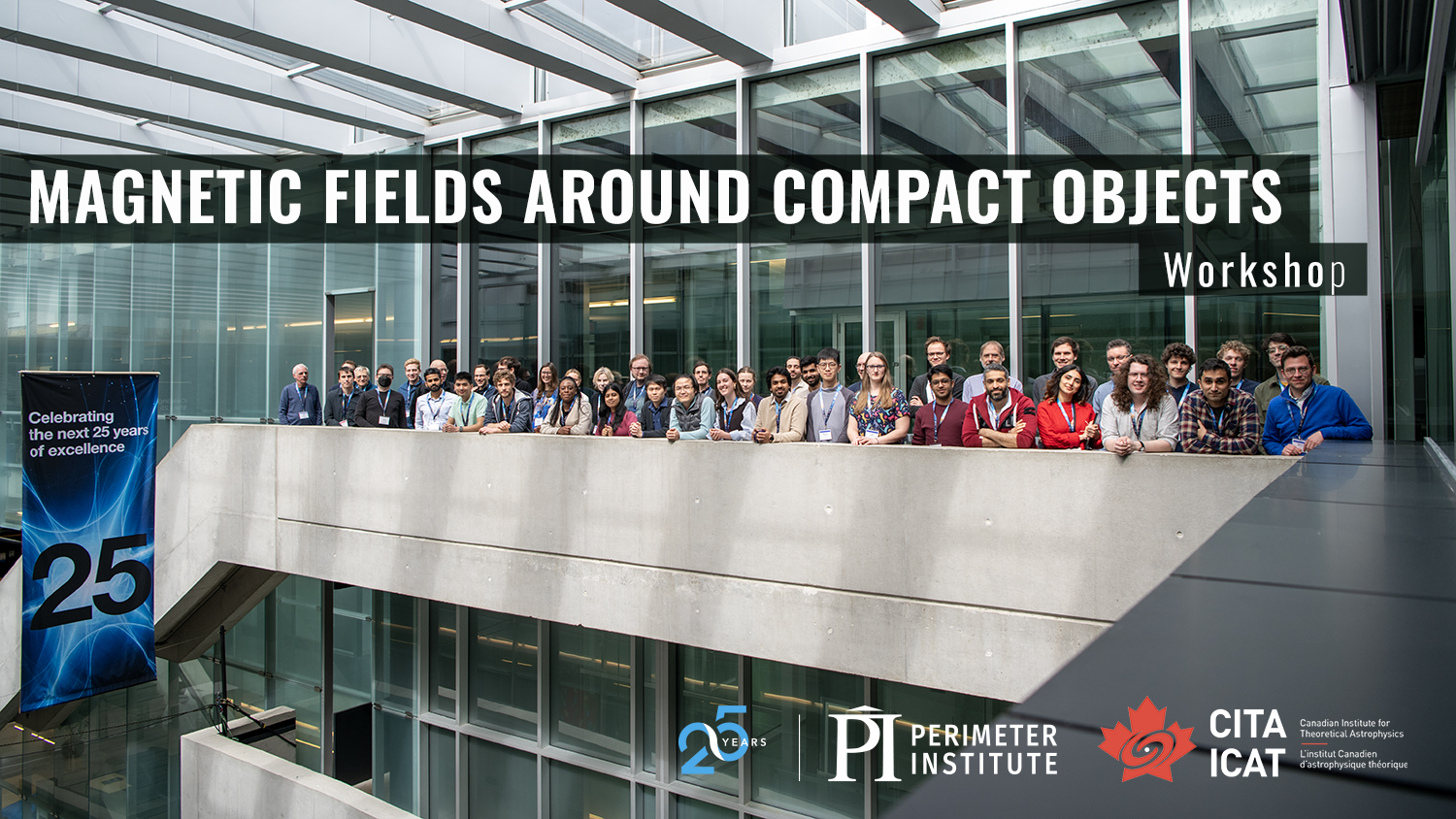
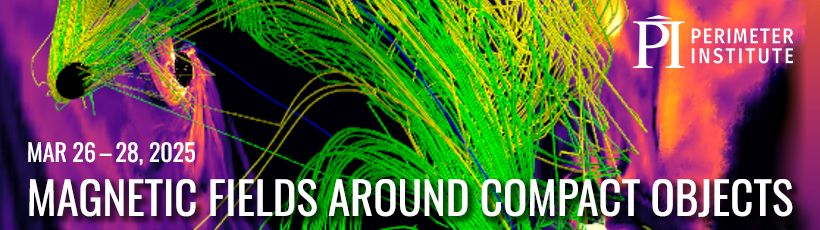 In the vicinity of neutron stars and black holes, where spacetime is strongly curved, magnetic fields can power many of the violent phenomena that we observe across the entire electromagnetic spectrum, from accretion and jet launching, to magnetar flares and pulsar emission. In the last decades, our theoretical understanding of the role of magnetic fields in these extreme environments has greatly improved through numerical simulations of magnetohydrodynamical fluids and charged kinetic particles; however, many open and important questions remain. Our observational capabilities and computational resources will keep growing dramatically in the next few years, allowing us to explore high-energy astrophysics in unprecedented regimes. Improving our knowledge of how magnetic fields, matter, and gravity interact with each other is a crucial piece in the new era of multimessenger astrophysics.
This workshop will gather experts from a wide range of disciplines within physics and astrophysics to present state-of-the-art advances in theoretical models of magnetic fields and high-energy plasma in different contexts, from neutron star mergers to supermassive black holes, and from micro scales to macro scales.
This workshop is sponsored in part by the Canadian Institute for Theoretical Astrophysics (CITA).
In the vicinity of neutron stars and black holes, where spacetime is strongly curved, magnetic fields can power many of the violent phenomena that we observe across the entire electromagnetic spectrum, from accretion and jet launching, to magnetar flares and pulsar emission. In the last decades, our theoretical understanding of the role of magnetic fields in these extreme environments has greatly improved through numerical simulations of magnetohydrodynamical fluids and charged kinetic particles; however, many open and important questions remain. Our observational capabilities and computational resources will keep growing dramatically in the next few years, allowing us to explore high-energy astrophysics in unprecedented regimes. Improving our knowledge of how magnetic fields, matter, and gravity interact with each other is a crucial piece in the new era of multimessenger astrophysics.
This workshop will gather experts from a wide range of disciplines within physics and astrophysics to present state-of-the-art advances in theoretical models of magnetic fields and high-energy plasma in different contexts, from neutron star mergers to supermassive black holes, and from micro scales to macro scales.
This workshop is sponsored in part by the Canadian Institute for Theoretical Astrophysics (CITA).
Scientific Organizers:
Luciano Combi (Perimeter Institute & U of Guelph)
Sean Ressler (CITA)
Bart Ripperda (CITA)
Luis Lehner (Perimeter Institute)
Will East (Perimeter Institute)
Gibwa Musoke (CITA)
Chris Thompson (CITA)
-
Emmy Noether Workshop: Quantum Space Time
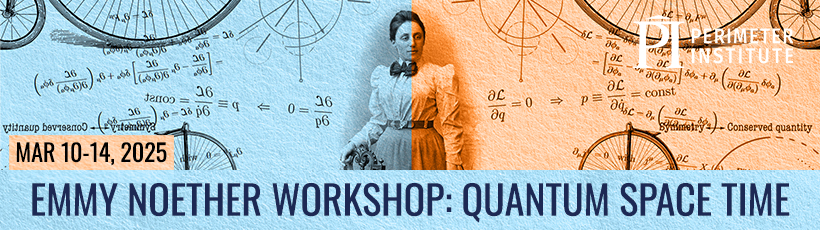
Constructing a theory of quantum gravity, and with it a notion of quantum spacetime is one of the biggest challenges faced by modern theoretical physics. This workshop will bring together researchers from a wide range of viewpoints and give them an opportunity to exchange ideas and gain new insights.
The workshop is supported by the Simons Foundation.

:: :: ::
Workshop Speakers
Marcela Carena (Perimeter Institute)
Astrid Eichhorn (Universität Heidelberg)
Netta Englehardt (MIT)
Johanna Erdmenger (University of Würzburg)
Gulia Gubitosi (University of Naples Federico II)
Renate Loll (Radboud University)
Jessica Muir (Perimeter Institute)
A.W. Peet (University of Toronto)
Alessia Platania (University of Copenhagen)
Jocelyn Read (California State University, Fullerton)
Kasia Rejzner (York University)
Mairi Sakellariadou (King's College London)
Sarah Shandera (Pennsylvania State University)
Sumati Surya (Raman Research Institute)
Karen Yeats (University of Waterloo):: :: ::
Scientific Organizers
Bianca Dittrich (Perimeter Institute)
Sabrina Pasterski (Perimeter Institute)
Céline Zwikel (Perimeter Institute)
Sruthi Narayanan (Perimeter Institute) -
Future Prospects of Intensity Interferometry

Recent advancements in photodetection technologies and spectroscopy hold the promise of transforming intensity interferometry, thereby revolutionizing observational Astronomy by enabling observations to resolve significantly fainter objects than currently possible. This workshop serves as a platform to unite experts in photodetection, theoretical and observational astronomy, as well as observers and theorists from diverse disciplines, to explore the multifaceted capabilities of intensity interferometry.
The workshop's focus spans three key objectives:
- Develop and disseminate novel ideas concerning science cases unique to intensity interferometry.
- Synthesize insights from observers and photodetector experts concerning the requisite technologies and experimental techniques which will allow for new science with intensity interferometry.
- Initiate a concentrated effort to propel the development of large telescope arrays dedicated to intensity interferometry.
This workshop will be exclusively organized in plenary sessions, providing ample time for engaging discussions among participants.
Scientific Organizers
Masha Baryakhtar - University of Washington
Neal Dalal - Perimeter Institute
Marios Galanis - Perimeter Institute
Junwu Huang - Perimeter Institute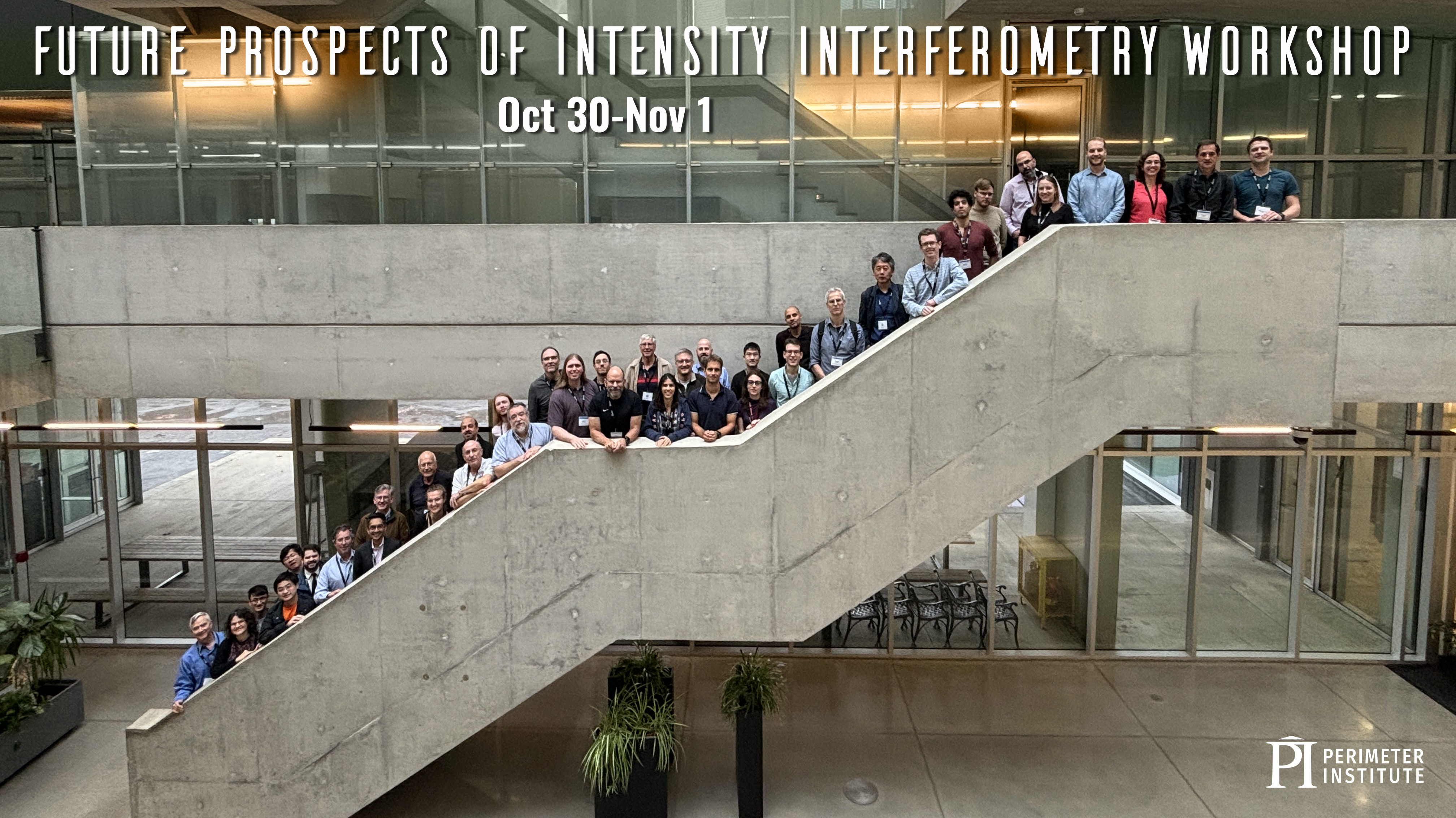
-
Waterloo-Munich Joint Workshop
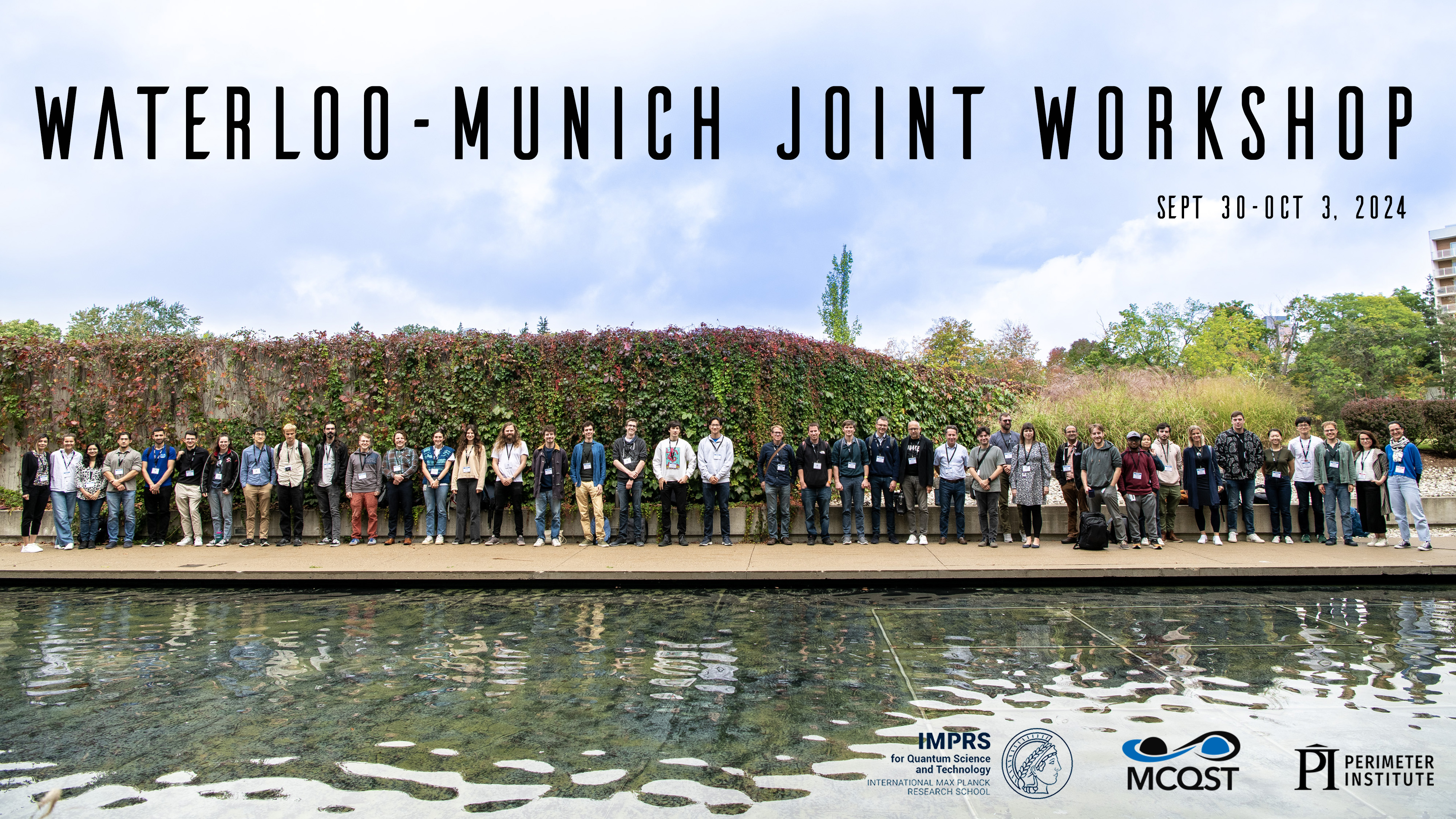
Join us for a pioneering joint workshop between renowned research institutions in Munich and Waterloo! This exciting event will focus on the topic of quantum simulation, with additional talks delving into various subjects of quantum science and technology. Designed to include researchers across different levels, from group leaders, postdoctoral fellows, and PhD students, this inaugural collaboration aims to unite scientists from both locations, fostering valuable networking opportunities and promoting interdisciplinary collaboration. Don't miss this extraordinary opportunity to connect, exchange ideas, and shape the future of quantum research together!

-
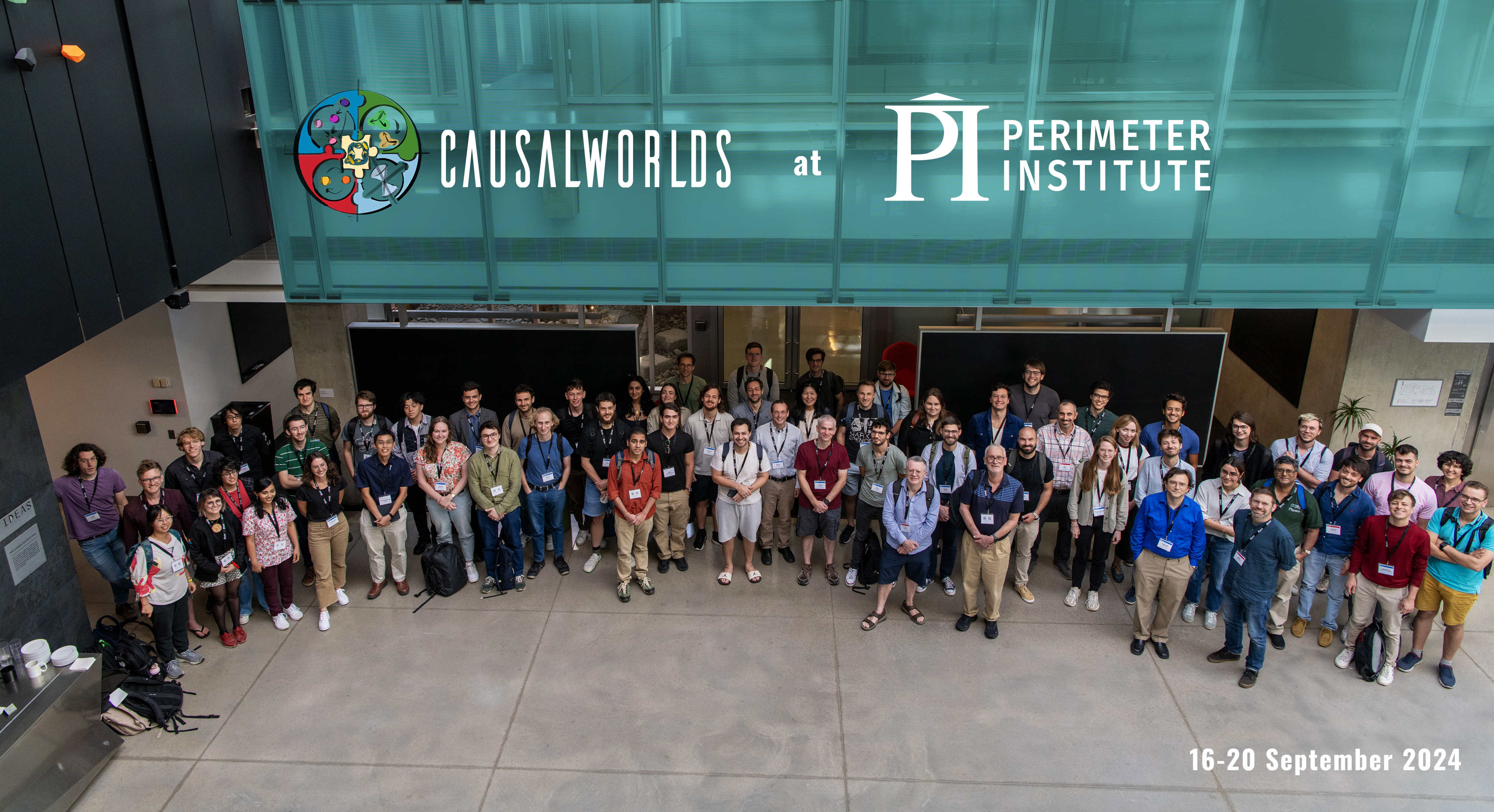
Causalworlds
Understanding causality is fundamental to science and inspires wide-ranging applications, yet there are several distinct notions of causation. Recently, there have been important developments on the role of causality in quantum physics, relativistic physics and their interplay. These have unearthed a plethora of fascinating open questions regarding the nature of causation, emergence of space-time structure and the limits of quantum information processing. At the same time, causal reasoning has become an important tool in machine learning and statistics, with applications ranging from big data to healthcare. This conference brings together experts from different areas of physics working on questions related to causality, as well as selected researchers who bridge the gap between fundamental research and current industrial applications. The aim of the conference is to provide a venue for cross-pollination of these ideas through scientific exchange between these communities. The conference will focus on the following facets of causality:
• Quantum and classical causal inference
• Indefinite causal order and quantum reference frames
• Causality in quantum field theory and quantum gravity
• Experiments and applications of causality

Sponsored in part by:

.png)
:: :: ::
Important dates
Paper submission deadline: 24 May 2024 // 31 May 2024
Paper notification: 3 July 2024 Registration deadline (with application for financial assistance): 18 July 2024
Registration deadline: 28 August 2024
Conference: 16-20 September 2024 Update: The submission deadline has been extended to 31st May 2024 for
papers which clearly justify their relevance for the following three
topics: 1) classical causal inference, 2) causality in relativistic physics (including quantum field theory and quantum gravity) and 3) experiments in causality. As we have received a sufficiently high number of submissions on the remaining topics (particularly indefinite causality and quantum causal models), the original deadline of 24th May still holds for submissions in this category. :: :: ::
Call for Abstracts
Prospective speakers can submit a paper for a contributed talk (in person or online) and/or a poster (in person only) via the Call for Abstracts. The Call for Abstracts is now open! Submissions for a talk will automatically be considered for a poster if not accepted for a talk.:: :: ::
Invited Speakers
Jessica Bavaresco (University of Geneva)
Cyril Branciard (CNRS, University Grenoble Alpes)
Rafael Chaves (Federal University of Rio Grande do Norte)
Giulio Chiribella (The University of Hong Kong)
Doreen Fraser (University of Waterloo)
Anne-Catherine de la Hamette (IQOQI Vienna)
Ciarán Lee (Spotify)
Tein van der Lugt (University of Oxford)
Joris M. Mooij (University of Amsterdam)
Mio Murao (University of Tokyo)
Alejandro Pozas-Kerstjens (University of Geneva)
Huw Price (Trinity College, Cambridge)
Renato Renner (ETH Zürich)
Thomas Richardson (University of Washington)
Sally Shrapnel (The University of Queensland)
Sumati Surya (Raman Research Institute)
Rainer Verch (University of Leipzig)
:: :: ::
Programme Committee
V Vilasini (ETH Zürich & Inria, University Grenoble Alpes) (PC Chair)
Augustin Vanrietvelde (Télécom Paris) (PC Co-chair)
Alastair Abbott (Inria, University Grenoble Alpes)
Časlav Brukner (IQOQI Vienna & University of Vienna)
Eric Cavalcanti (Griffith University)
Chris Fewster (University of York)
Lucien Hardy (Perimeter Institute)
Hlér Kristjánsson (Perimeter Institute & IQC & Université de Montréal)
Giulia Rubino (University of Bristol)
Nitica Sakharwade (Università degli Studi di Napoli Federico II)
Robert Spekkens (Perimeter Institute)
Jacopo Surace (Perimeter Institute)
Elie Wolfe (Perimeter Institute)
Lin-Qing Chen (ETH Zürich & IQOQI Vienna)
Hippolyte Dourdent (ICFO Barcelona)
Tamal Guha (University of Hong Kong)
Robin Lorenz (Quantinuum, Oxford)
Maria Papageorgiou (IQOQI Vienna)
Nicola Pinzani (Université libre de Bruxelles)
Marco-Túlio Quintino (Sorbonne Université, Paris)
Marc-Olivier Renou (Inria Paris-Saclay & CPHT, École polytechnique)
David Schmid (ICTQT, University of Gdańsk)
John Selby (ICTQT, University of Gdańsk)
Akihito Soeda (National Institute of Informatics, Tokyo)
Matthew Wilson (University College London)
:: :: ::
Scientific Organizers
Hlér Kristjánsson (Perimeter Institute & IQC & Université de Montréal) (Chair)
V Vilasini (ETH Zürich & Inria, University Grenoble Alpes)
Robert Spekkens (Perimeter Institute)
Lucien Hardy (Perimeter Institute)
Elie Wolfe (Perimeter Institute)
Jacopo Surace (Perimeter Institute)
Marina Maciel Ansanelli (Perimeter Institute)
Yìlè Yīng (Perimeter Institute)
María Ciudad Alañón (Perimeter Institute)
Daniel Centeno Díaz (Perimeter Institute)
Khushi Gandhi (Perimeter Institute & University of Waterloo):: :: ::
Previous editions:
Causalworlds 2022: The interface between quantum and relativistic causality, foundations and practicalities
Organised at ETH Zürich in 2022. Website: https://causalworlds.ethz.ch/" -
Perimeter Institute Graduate Students' Conference 2024
The annual Graduate Students’ Conference showcases the diverse research directions at Perimeter Institute, both organized and presented by the students. Our graduate students are invited to share their best work with their fellow PhD students, PSI students and other PI residents interested in hearing about physics research and discussing it in a lively atmosphere full of questions.
PSI students are welcome to join as audience members on Friday, Sept 13 and to present a Lightning Talk if they wish to do so.
-
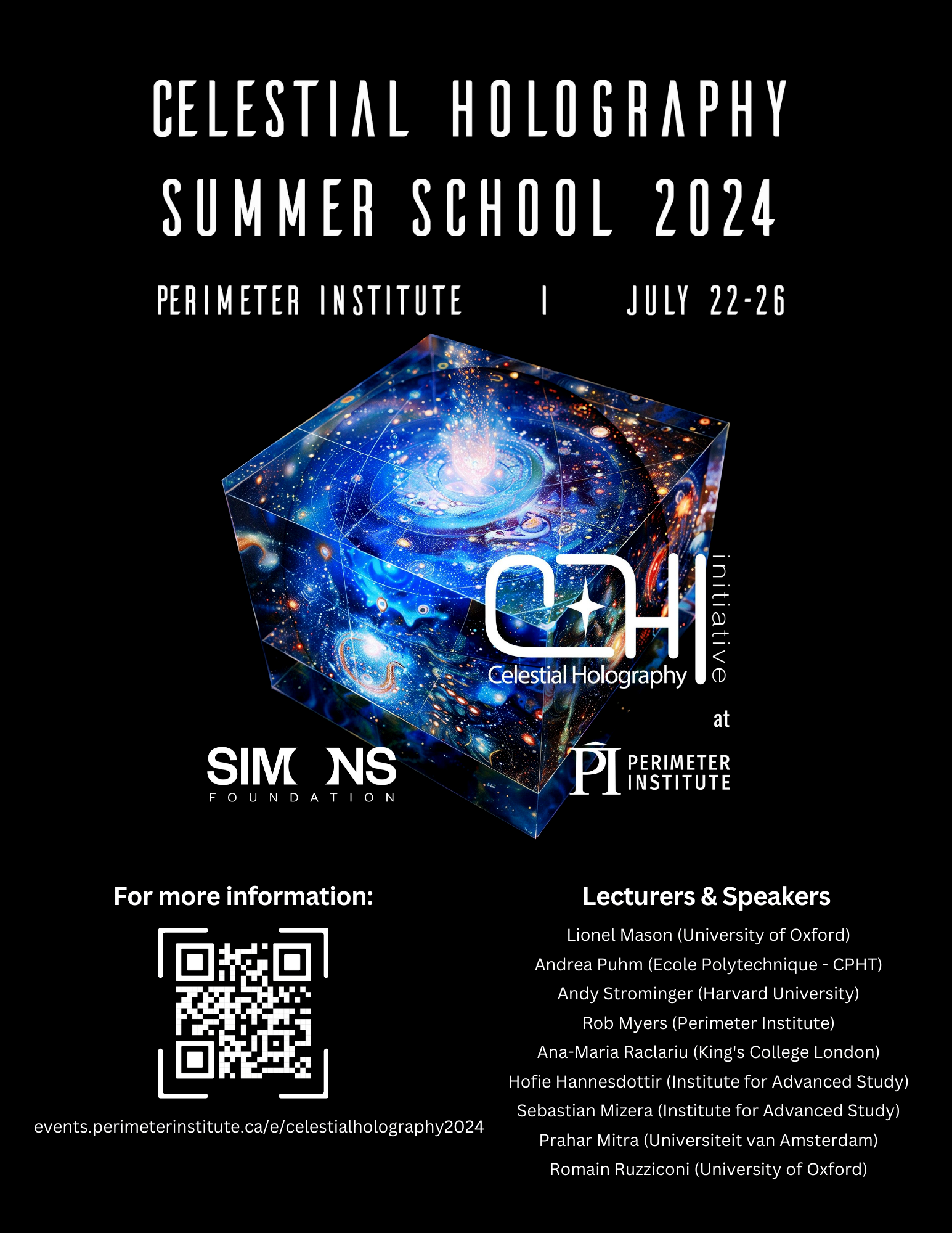
Celestial Holography Summer School 2024
Perimeter Institute is happy to host the inaugural summer school for the Simons Collaboration on Celestial Holography July 22-26 in Waterloo, ON. The program will feature lectures on background material relevant for graduate students and postdocs interested in this emerging subfield, paired with vision talks on exciting future research directions.
:: :: ::
-
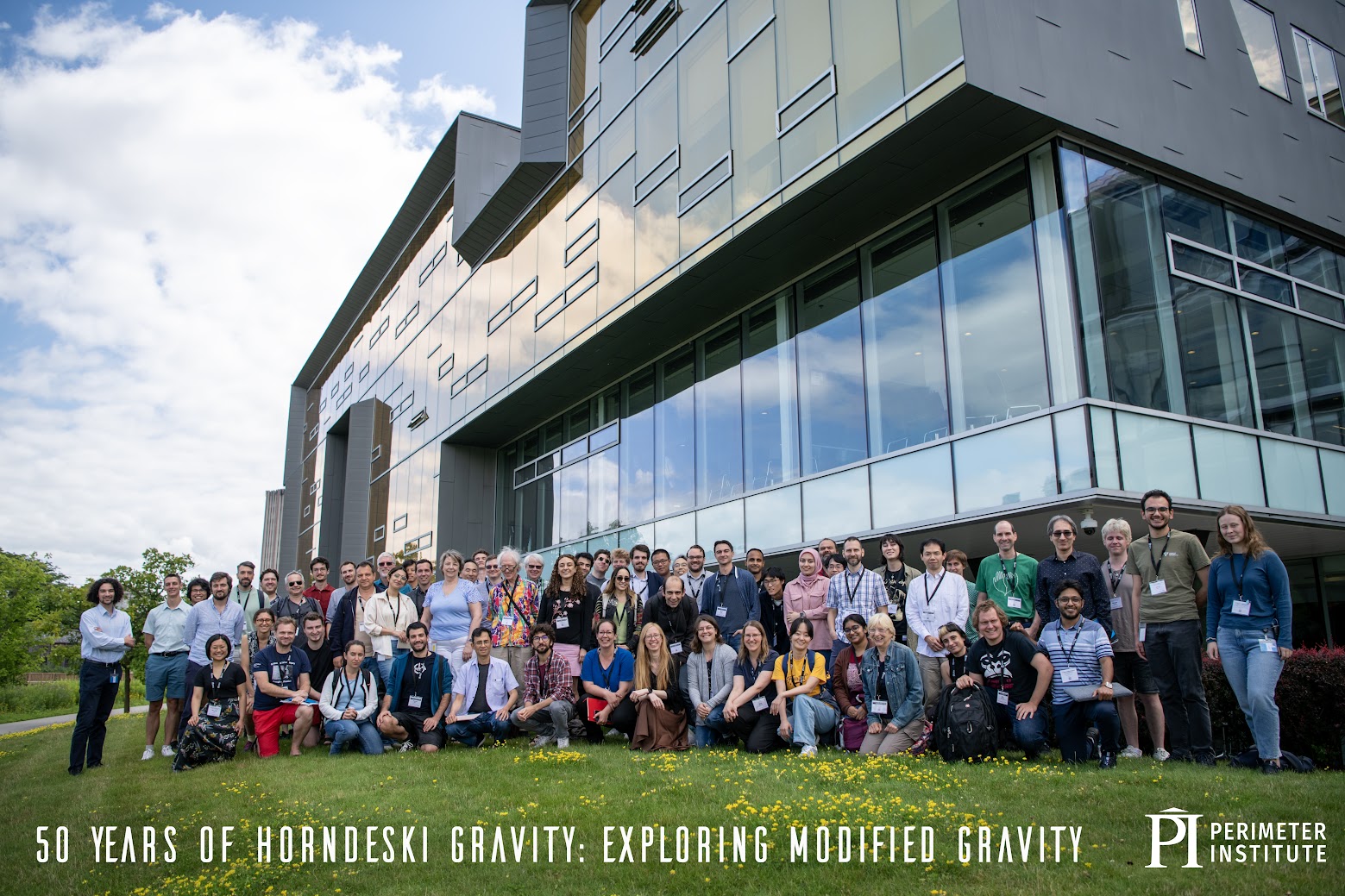
50 Years of Horndeski Gravity: Exploring Modified Gravity

Recent years have seen a flood of new data, from gravitational wave observations of merging black holes and neutron stars to precision probes of cosmology, which allow for unprecedented tests of our understanding of gravity. Going hand-in-hand with this, there has been significant recent progress on the theoretical side in terms of formulating modified theories of gravity, and using them to make detailed predictions, including in the nonlinear and dynamical regime, which can be confronted with the observations.
We are excited to announce a landmark conference that plans to delve into the forefront of research on modified theories of gravity and brings together leading experts from different disciplines including observational astrophysicists, numerical relativists, cosmologists and mathematical physicists to explore the present status of modified theories of gravity and envision their future theoretical development and implications for observations.
This conference is also timed to coincide with the 50th anniversary of pioneering work in this area carried out by Gregory Horndeski in the Waterloo Mathematical Physics Community. Hosted jointly by Perimeter Institute and the University of Waterloo, this conference will serve as a forum for researchers from different disciplines to exchange ideas at the cutting
edge of gravitational physics.
Presented by:

Sponsored in part by Gravity Theory Trust
:: :: ::Topics:
• Modified Gravity Theories: Theoretical Framework and Models
• Tests of modified Gravity with Gravitational Waves (LIGO/LISA/PTA)
• Astrophysical/cosmological tests of gravity
• Mathematical structure of Modified gravity
• Observational tests of quantum gravity
• Modified gravity in the early universeConference Structure:
The conference will feature a balanced blend of plenary sessions (invited Speakers), contributed talks, panel discussions and poster presentations for students.
• Keynote presentations by renowned physicists in the field, discussing the impact of Horndeski theories and other modified theories of gravity on cosmology, dark energy, and black hole physics.
• Contributed talks: prioritizing early-career researchers
• Panel discussions on emerging research directions, unresolved questions, and potential applications of Horndeski theories.
• Poster sessions for early-career researchers and graduate students to showcase their work and receive feedback from senior scientists.:: :: ::
Scientific Organizers:
- Ghazal Geshnizjani (Perimeter Institute, SOC Chair)
- William East (Perimeter Institute)
- Levon Pogosian (Simon Fraser University, Perimeter Institute Affiliate)
- Niayesh Afshordi (Perimeter Institute, U Waterloo, LOC Chair)
- Will Percival (Perimeter Institute, U Waterloo)
- Florian Girelli (U Waterloo, Perimeter Institute Affiliate)
- Jerome Quintin (U Waterloo, Perimeter Institute)
- Alex Krolewski (U Waterloo, Perimeter Institute, CITA)
:: :: ::