


Format results
-
Talk
-
Opening Remarks
-
Marcela Carena Perimeter Institute for Theoretical Physics
-
Kendrick Smith Perimeter Institute for Theoretical Physics
-
-
Cosmology: the last 25 years
Matias Zaldarriaga -
Measuring H0 and dark energy with DESI
Will Percival University of Waterloo
-
-
-
Observable B modes from Cosmological Phase Transitions
Gordon Krnjaic -
Neutron Star Mergers: Probes of Extreme Matter
Pablo Bosch Gomez -
Can LIGO Detect Daylight Savings Time?
Reed Essick
-
-
Talk
-
Opening Remarks
Selim Hotinli Perimeter Institute for Theoretical Physics
-
-
-
Baryon feedback: How extreme is too extreme?
Alexandra Amon Princeton University
-
Cosmological feedback from a halo assembly perspective
Hiranya Peiris University of Cambridge
-
-
-
-
-
Talk
-
Lecture - Cosmology, PHYS 621
Neal Dalal Perimeter Institute for Theoretical Physics
-
Lecture - Cosmology, PHYS 621
Neal Dalal Perimeter Institute for Theoretical Physics
-
Lecture - Cosmology, PHYS 621
Neal Dalal Perimeter Institute for Theoretical Physics
-
Lecture - Cosmology, PHYS 621
Neal Dalal Perimeter Institute for Theoretical Physics
-
Lecture - Cosmology, PHYS 621
Neal Dalal Perimeter Institute for Theoretical Physics
-
Lecture - Cosmology, PHYS 621
Neal Dalal Perimeter Institute for Theoretical Physics
-
Lecture - Cosmology, PHYS 621
Neal Dalal Perimeter Institute for Theoretical Physics
-
Lecture - Cosmology, PHYS 621
Neal Dalal Perimeter Institute for Theoretical Physics
-
-
Talk
-
Lecture - Gravitational Physics, PHYS 636
Ruth Gregory King's College London
-
Lecture - Gravitational Physics, PHYS 636
Ruth Gregory King's College London
-
Lecture - Gravitational Physics, PHYS 636
Ruth Gregory King's College London
-
Lecture - Gravitational Physics, PHYS 636
Ruth Gregory King's College London
-
Lecture - Gravitational Physics, PHYS 636
Ruth Gregory King's College London
-
Lecture - Gravitational Physics, PHYS 636
Ruth Gregory King's College London
-
Lecture - Gravitational Physics, PHYS 636
Ruth Gregory King's College London
-
Lecture - Gravitational Physics, PHYS 636
Ruth Gregory King's College London
-
-
Talk
-
Lecture - Relativity, PHYS 604
Ghazal Geshnizjani Perimeter Institute for Theoretical Physics
-
Lecture - Relativity, PHYS 604
Ghazal Geshnizjani Perimeter Institute for Theoretical Physics
-
Lecture - Relativity, PHYS 604
Ghazal Geshnizjani Perimeter Institute for Theoretical Physics
-
Lecture - Relativity, PHYS 604
Ghazal Geshnizjani Perimeter Institute for Theoretical Physics
-
Lecture - Relativity, PHYS 604
Ghazal Geshnizjani Perimeter Institute for Theoretical Physics
-
Lecture - Relativity, PHYS 604
Ghazal Geshnizjani Perimeter Institute for Theoretical Physics
-
Lecture - Relativity, PHYS 604
Ghazal Geshnizjani Perimeter Institute for Theoretical Physics
-
Lecture - Relativity, PHYS 604
Ghazal Geshnizjani Perimeter Institute for Theoretical Physics
-
-
Talk
-
-
Intensity correlations: imaging and quantum optics in astrophysics
Robin Kaiser The French National Centre for Scientific Research
-
Intensity Interferometry with the H.E.S.S. telescopes
Naomi Vogel ECAP, FAU Erlangen-Nürnberg
-
Progress Toward Multi-Channel Intensity Interferometry with the Southern Connecticut Stellar Interferometer
Elliott Horch Southern Connecticut State University
-
-
The Multi Aperture Spectroscopic Telescope: Status and potential as an intensity interferometry facility
Sagi Ben Ami Weizmann Institute of Science
-
-
Future Astrophysical Targets for Intensity Interferometry
Norman Murray University of Toronto
-
-
Talk
-
-
-
Horndeski Gravity in Cosmology
Alessandra Silvestri Leiden University
-
How we rediscovered Horndeski gravity
Cedric Deffayet Institut d'Astrophysique de Paris
-
Black holes in Horndeski theories
Christos Charmousis The French National Centre for Scientific Research
-
Hi-COLA: Horndeski Goes Non-linear
Tessa Baker University of Portsmouth
-
Photon Rings and Shadow Size for General Axi-Symmetric and Stationary Integrable spacetimes
Kiana Salehi perimeter institute and university of Waterloo
PIRSA:24070086 -
Modified gravity getting to the one-point clustering statistics
Cora Uhlemann Bielefeld University
PIRSA:24070087
-
-
Talk
-
Cosmology Lecture
Kendrick Smith Perimeter Institute for Theoretical Physics
-
Cosmology Lecture
Kendrick Smith Perimeter Institute for Theoretical Physics
-
Cosmology Lecture
Kendrick Smith Perimeter Institute for Theoretical Physics
-
Cosmology Lecture
Kendrick Smith Perimeter Institute for Theoretical Physics
-
Cosmology Lecture
Kendrick Smith Perimeter Institute for Theoretical Physics
-
Cosmology Lecture
Kendrick Smith Perimeter Institute for Theoretical Physics
-
Cosmology Lecture
Kendrick Smith Perimeter Institute for Theoretical Physics
-
Cosmology Lecture
Kendrick Smith Perimeter Institute for Theoretical Physics
-
-
Talk
-
Opening Remarks
-
Katie Mack Perimeter Institute
-
Aaron Vincent Queen's University
-
-
Dark and visible structures with dissipative dark matter
Sarah Shandera Pennsylvania State University
-
-
-
The First Stars in the Universe as Dark Matter Laboratories
Cosmin Ilie Colgate University
-
Probing Atomic Dark Matter using Simulated Galactic Subhalo Populations
Caleb Gemmell University of Toronto
-
Dark matter at high redshifts with JWST
Julian Munoz The University of Texas at Austin
-
(Dark) Baryogenesis through Asymmetric Reheating in the Mirror Twin Higgs.
Andrija Rasovic University of Toronto
-
-
Talk
-
Lessons of the Effective Field Theory Treatment of General Relativity
John Donoghue University of Massachusetts Amherst
-
Positivity Bounds and Effective Fields Theories (A Review)
Andrew Tolley Imperial College London
-
Holography and its implications for quantum gravity - VIRTUAL
Johanna Erdmenger University of Würzburg
-
A hike through the Swamp
Miguel Mlontero IFT Madrid
-
Piecing Together a Flat Hologram
Sabrina Pasterski Perimeter Institute for Theoretical Physics
-
Open Discussion with today's speakers (Donoghue, Erdmenger, Montero, Pasterski, Tolley)
-
John Donoghue University of Massachusetts Amherst
-
Johanna Erdmenger University of Würzburg
-
Miguel Mlontero IFT Madrid
-
Sabrina Pasterski Perimeter Institute for Theoretical Physics
-
Andrew Tolley Imperial College London
-
-
Panel Discussion - Strengths and limitations of EFT (Donoghue, Knorr, Montero, Quevedo, Tolley)
-
John Donoghue University of Massachusetts Amherst
-
Miguel Mlontero IFT Madrid
-
Fernando Quevedo University of Cambridge
-
Carlo Rovelli Aix-Marseille University
-
Andrew Tolley Imperial College London
-
-
-
-
Talk
-
-
Simulating one-dimensional quantum chromodynamics on a quantum computer: Real-time evolutions of tetra- and pentaquarks
Christine Muschik Institute for Quantum Computing (IQC)
-
-
Five short talks - see description for talk titles
-
Barbara Soda Perimeter Institute for Theoretical Physics
-
Dalila Pirvu Invisible Technologies
- Leonardo Solidoro, Pietro Smaniotto, Kate Brown
-
-
First observations of false vacuum decay in a BEC
Ian Moss Newcastle University
-
Building Quantum Simulators for QuFTs
Jorg Schmiedmayer Technical University of Vienna
-
-
-
-
Talk
-
Welcome and Opening Remarks
Niayesh Afshordi University of Waterloo
-
Quantum Gravity and its connection to observations
Astrid Eichhorn Universität Heidelberg
-
-
The Spacetime of Acceleration
Ruth Gregory King's College London
-
What is the simplicity of the early universe trying to tell us?
Latham Boyle University of Edinburgh
-
Are we considering enough? Inclusivity in Quantum Gravity and Cosmology
Jarita Holbrook University of Edinburgh
-
-
Emergent Metric Space-Time from the BFSS Matrix Model
Robert Brandenberger McGill University - Department of Physics
-
-
Charting the Future Symposium
Charting the Future Symposium: Big questions in particle physics, strong gravity, and cosmology over the next 25 years
Join us for a special symposium celebrating Perimeter’s 25th anniversary. This event offers a unique opportunity to unite Perimeter alumni and friends in the fields of cosmology, particle physics, and strong gravity with our extended community, reflect on a quarter-century of discovery, and look ahead to the challenges and opportunities that will shape the next 25 years of fundamental physics.
Over the past quarter-century, we have witnessed transformative advances across our fields. In particle physics, the discovery of the Higgs boson crowned decades of effort, while precision experiments continue to probe the Standard Model and search for new physics. In strong gravity, the direct detection of gravitational waves has opened a new observational window onto black holes, neutron stars, and the very fabric of spacetime. In cosmology, precision measurements of the cosmic microwave background and large-scale structure have revolutionized our understanding of the universe’s origins and evolution, even as dark matter and dark energy remain profound mysteries.
As we look to the future, a new generation of experiments, observations, and theoretical ideas promises to drive further revolutions. From uncovering physics beyond the Standard Model to probing the nature of spacetime and the earliest moments of the cosmos, the next 25 years are poised to be as transformative as the last.
This symposium will bring together leading researchers, young scientists, alumni, and friends to celebrate past achievements, and imagine the discoveries yet to come. We invite you to be part of this landmark event at Perimeter Institute, as we honor the spirit of curiosity, ambition, and collaboration that has defined our journey so far — and will carry us forward.

Invited Speakers
- Haipeng An (Tsinghua University)
- Masha Baryakhtar (University of Washington)
- Brian Batell (University of Pittsburgh)
- Laura Bernard (Observatoire de Paris)
- Richard Bond (CITA)
- Pablo Bosch Gomez (Utrecht University)
- Latham Boyle (University of Edinburgh)
- Patrick Brady (University of Wisconsin-Milwaukee)
- Joe Bramante (Queen's University)
- Savas Dimopoulos (Perimeter Institute)
- Adrienne Erickcek (University of North Carolina at Chapel Hill)
- Stefania Gori (UC Santa Cruz)
- Chad Hanna (Pennsylvania State)
- Renée Hložek (University of Toronto)
- Yoni Kahn (University of Toronto)
- Vicky Kaspi (McGill University)
- Gordan Krnjaic (Fermilab)
- Ian Low (Northwestern University)
- Mathew Madhavacheril (University of Pennsylvania)
- David Morissey (TRIUMF)
- Moritz Münchmeyer (University of Wisconsin-Madison)
- Ue-Li Pen (CITA, Perimeter Institute)
- Will Percival (Perimeter Institute)
- Maxim Pospelov (University of Minnesota)
- Josef Pradler (Austrian Academy of Sciences)
- Daniel Siegel (University of Greifswald)
- Nils Siemonsen (Princeton University)
- Carlos Wagner (University of Chicago)
- Huan Yang (Tsinghua University)
- Matias Zaldarriaga (IAS)
:: :: ::
Organizing Committee
Asimina Arvanitaki
Luis Lehner
Sergey Sibiryakov
Kendrick Smith -
Cosmic Ecosystems
 In the past three decades, one of the most transformative insights in cosmology has been the realisation that the formation and evolution processes of cosmic structures such as supermassive black-holes, galaxies and clusters are deeply interconnected with the vast cosmic web that underpins the Universe. These processes do not happen in isolation, but are part of a dynamic ecosystem where matter and energy flow across scales, driving the growth and transformation of cosmic environments. Understanding this complex system, in particular the circum-galactic medium (CGM), is not only key to deciphering how matter is cycled and redistributed through accretion via filaments and outflows from AGN and supernovae, but also crucial for unlocking the next generation of discoveries in areas such as dark matter, the behaviour of the cosmic web, the forces that shape cosmic evolution, and more.This conference seeks to bring together cosmologists and astrophysicists to foster collaborative exploration of these interconnected cosmic ecosystems. By focusing on how structures interact with their environments across cosmic scales, this conference aims to catalyse groundbreaking discoveries in both astronomy and physics, providing fresh insights into the forces that govern the Universe. Special attention will be given to the joint analysis of large-scale structure and weak gravitational lensing data from surveys such as DESI, Euclid, LSST and Roman with CMB data from the Simons Observatory and CMB-S4, as well as how these can be integrated with observations of JWST, and existing and upcoming observations of X-ray emission, UV/X-ray absorption toward quasars, 21-cm emission, and FRBs.The goal is to explore the complementarity of these data sets and how their alignment can provide new insights into the interconnected processes shaping cosmic environments, particularly through joint modelling and simulations of many phases of gas and feedback across different regimes. Attention will also be given to bridging the gap between how cosmologists and astronomers approach the CGM, either top-down large-scale and hot and virial phase, vs bottom-up, cooler phases, at smaller scales.Topics will include:· Cosmic mass budget, including a census of where the baryons are.· Effect of baryons on dark matter structures on small and large scales.· Cosmic evolution of large-scale structures.· Bridging the gap between different probes.
Please see the Conference Themes for a more complete list of example topics.The time has never been more right to unify these fields, as advances in observation, theory and simulations are poised to open new paths to revealing the cosmos’ most profound mysteries.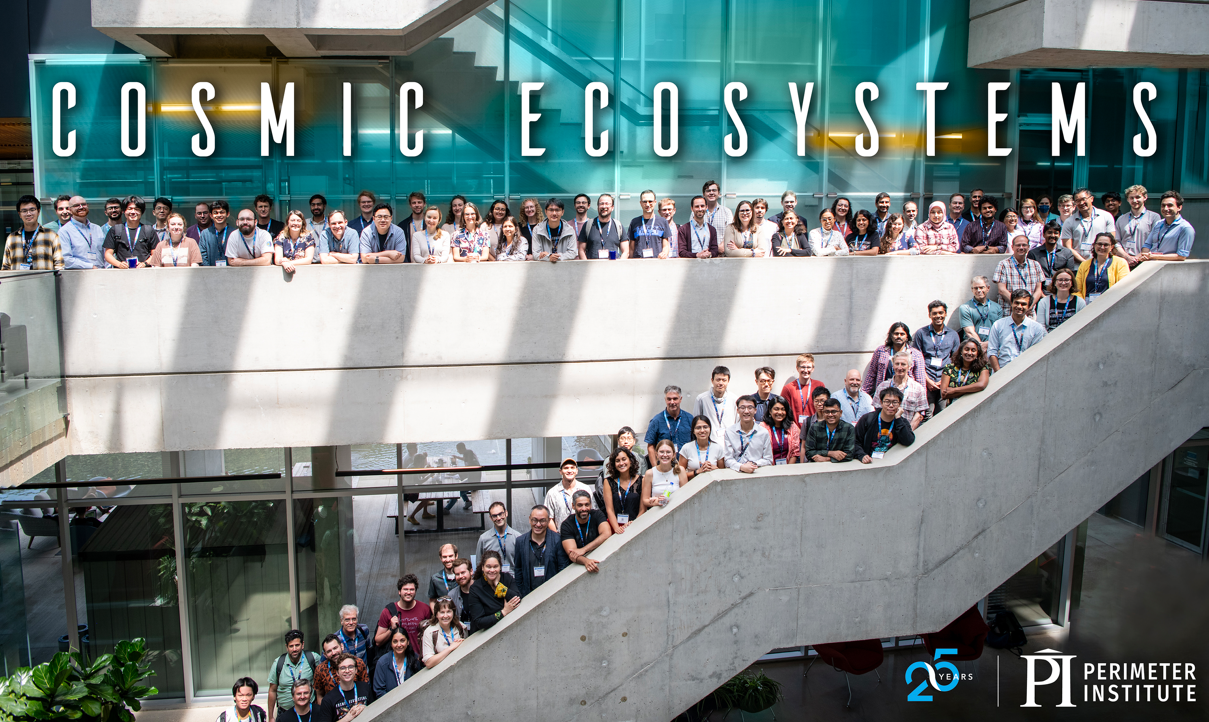
:: :: ::
Organizing Committee (LOC)
Selim Hotinli (Perimeter Institute)
Neal Dalal (Perimeter Institute)
Mike Hudson (University of Waterloo, Waterloo Centre for Astrophysics)
Matt Johnson (Perimeter Institute)
Katie Mack (Perimeter Institute)
Brian McNamara (University of Waterloo, Waterloo Centre for Astrophysics)
Arielle Phillips (University of Notre Dame / Simons Emmy Noether Fellow at Perimeter Institute)
Kendrick Smith (Perimeter Institute)
Scientific Organizing Committee (SOC)
Nick Battaglia (Cornell)
Hsiao-Wen Chen (University of Chicago)
Megan Donahue (Michigan State University)
Claude-André Faucher-Giguère (Northwestern)
Cameron Hummels (Caltech)
Selim Hotinli (Perimeter Institute)
Ian McCarthy (Liverpool John Moores University)
Daisuke Nagai (Yale)
Gwen Rudie (Carnegie Institution for Science)
Freeke van de Voort (Cardiff University)
Jessica Werk (University of Washington)
Confirmed Speakers
Alexandra Amon (Princeton)
Iryna Butsky (Stanford)
William Coulton (Cambridge University)
Sanskrti Das (Stanford)
Simone Ferraro (Berkeley Lab)
Nicholas J Frontiere (Argonne)
Vera Gluscevic (USC)*
Timothy Heckman (JHU)*
Boryana Hadzhiyska (UC Berkeley & Berkeley Lab)*
Stella Koch Ocker (California Institute of Technology)
Khee-Gan Lee (IPMU)*
Nir Mandelker (Hebrew University Jerusalem)
Chris Martin (Caltech)
Daisuke Nagai (Yale)
Andrew Newman (Carnegie Institution for Science)
Peng Oh (UC Santa Barbara)
Hiranya Peiris (University of Cambridge)
Andrew Pontzen (Durham University)
Emanuel Schaan (SLAC)
Joop Schaye (Leiden University)*
Chuck Steidel (California Institute of Technology)
Jonathan Stern (Tel Aviv University)
Mark Voit (Michigan State University)
Irina Zhuravleva (University of Chicago)
*Virtual presenters
-
Cosmology (Elective), PHYS 621, March 31 - May 2, 2025
This course in Cosmology provides a theoretical overview of the standard cosmological model. Key topics include the FRW metric and the homogeneous universe, the thermal history of the universe (with an emphasis on the hot Big Bang and equilibrium thermodynamics), inflation and scalar field dynamics, along with selected aspects of cosmological perturbation theory (time permitting). Instructor: Neal Dalal/Ghazal Geshnizjani Students who are not part of the PSI MSc program should review enrollment and course format information here: https://perimeterinstitute.ca/graduate-courses -
Gravitational Physics (Elective), PHYS 636, January 6 - February 5, 2025
The main objective of this course is to discuss some advanced topics in gravitational physics and its applications to high energy physics. Necessary mathematical tools will be introduced on the way. Instructor: Ruth Gregory/Aldo Riello Students who are not part of the PSI MSc program should review enrollment and course format information here: https://perimeterinstitute.ca/graduate-courses -
Relativity (Core), PHYS 604, November 12 - December 11, 2024
This course offers an introduction to general relativity (GR), focusing on the core principles of Einstein's theory of gravity. We will explore key topics such as the equivalence principle, some essential concepts in differential geometry, the Einstein-Hilbert action, and Einstein's field equations. Furthermore, we will examine practical applications of general relativity in understanding black holes, cosmology, and gravitational waves. Instructor: Ghazal Geshnizjani Students who are not part of the PSI MSc program should review enrollment and course format information here: https://perimeterinstitute.ca/graduate-courses -
Future Prospects of Intensity Interferometry

Recent advancements in photodetection technologies and spectroscopy hold the promise of transforming intensity interferometry, thereby revolutionizing observational Astronomy by enabling observations to resolve significantly fainter objects than currently possible. This workshop serves as a platform to unite experts in photodetection, theoretical and observational astronomy, as well as observers and theorists from diverse disciplines, to explore the multifaceted capabilities of intensity interferometry.
The workshop's focus spans three key objectives:
- Develop and disseminate novel ideas concerning science cases unique to intensity interferometry.
- Synthesize insights from observers and photodetector experts concerning the requisite technologies and experimental techniques which will allow for new science with intensity interferometry.
- Initiate a concentrated effort to propel the development of large telescope arrays dedicated to intensity interferometry.
This workshop will be exclusively organized in plenary sessions, providing ample time for engaging discussions among participants.
Scientific Organizers
Masha Baryakhtar - University of Washington
Neal Dalal - Perimeter Institute
Marios Galanis - Perimeter Institute
Junwu Huang - Perimeter Institute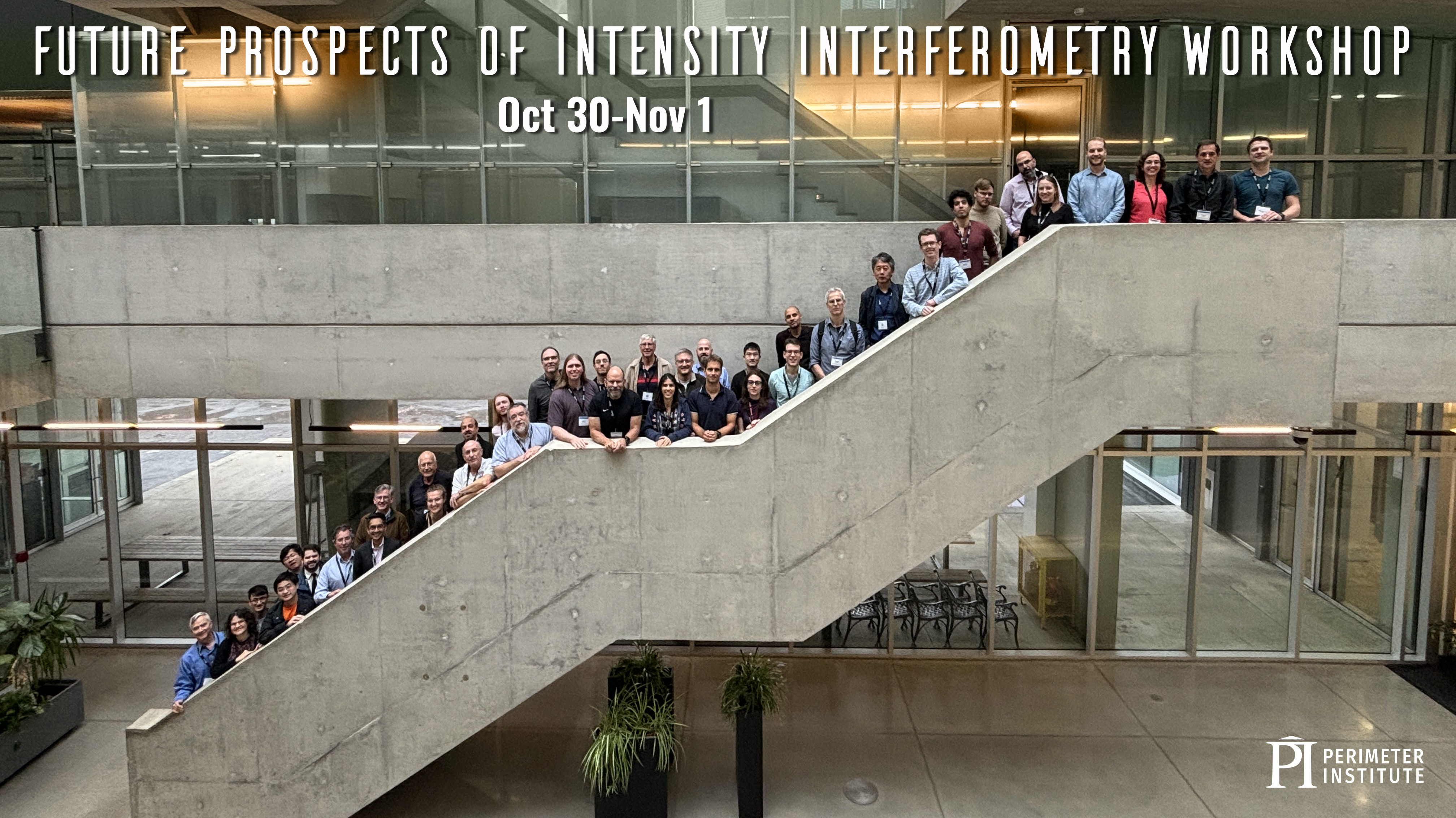
-
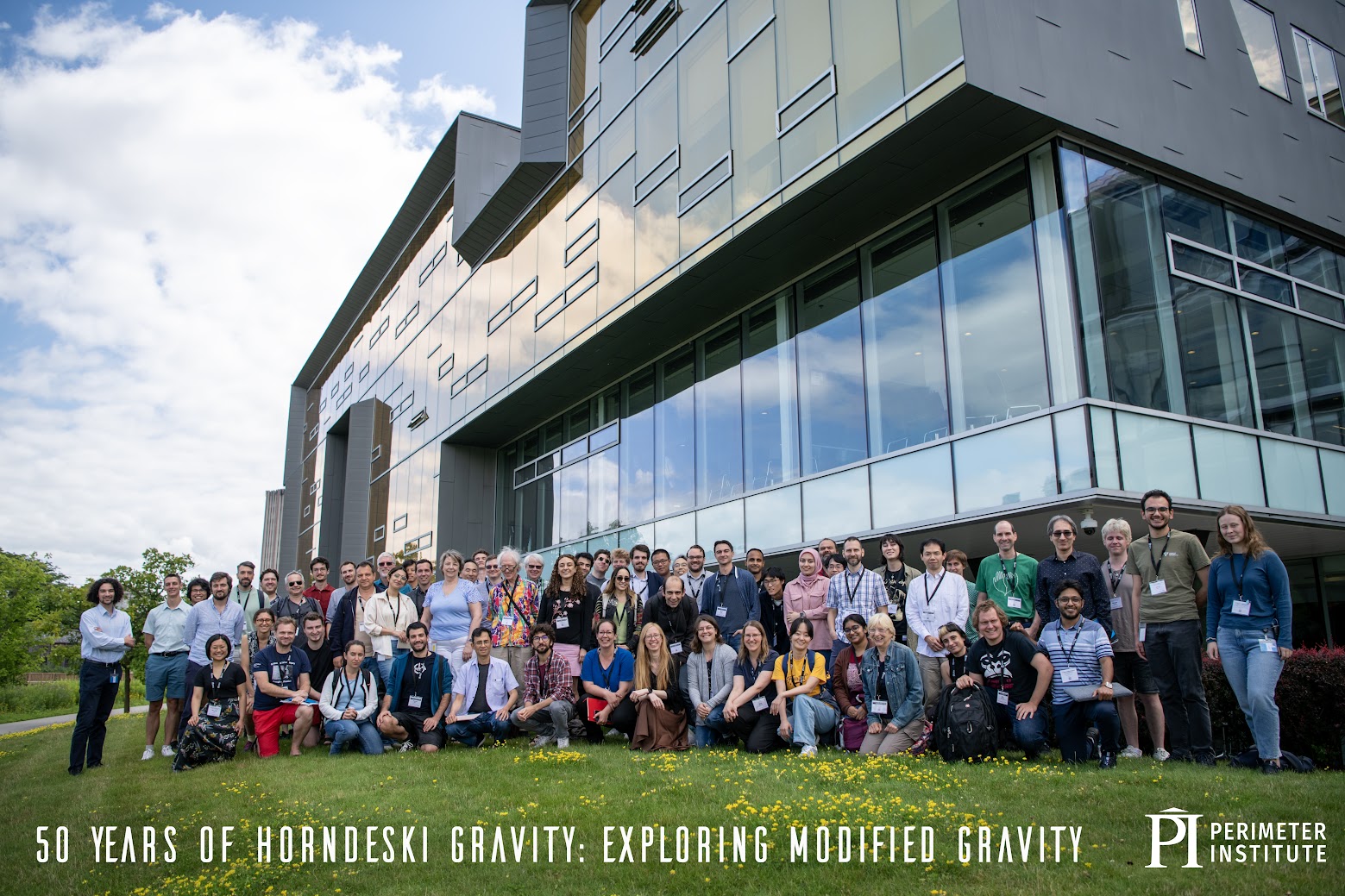
50 Years of Horndeski Gravity: Exploring Modified Gravity

Recent years have seen a flood of new data, from gravitational wave observations of merging black holes and neutron stars to precision probes of cosmology, which allow for unprecedented tests of our understanding of gravity. Going hand-in-hand with this, there has been significant recent progress on the theoretical side in terms of formulating modified theories of gravity, and using them to make detailed predictions, including in the nonlinear and dynamical regime, which can be confronted with the observations.
We are excited to announce a landmark conference that plans to delve into the forefront of research on modified theories of gravity and brings together leading experts from different disciplines including observational astrophysicists, numerical relativists, cosmologists and mathematical physicists to explore the present status of modified theories of gravity and envision their future theoretical development and implications for observations.
This conference is also timed to coincide with the 50th anniversary of pioneering work in this area carried out by Gregory Horndeski in the Waterloo Mathematical Physics Community. Hosted jointly by Perimeter Institute and the University of Waterloo, this conference will serve as a forum for researchers from different disciplines to exchange ideas at the cutting
edge of gravitational physics.
Presented by:

Sponsored in part by Gravity Theory Trust
:: :: ::Topics:
• Modified Gravity Theories: Theoretical Framework and Models
• Tests of modified Gravity with Gravitational Waves (LIGO/LISA/PTA)
• Astrophysical/cosmological tests of gravity
• Mathematical structure of Modified gravity
• Observational tests of quantum gravity
• Modified gravity in the early universeConference Structure:
The conference will feature a balanced blend of plenary sessions (invited Speakers), contributed talks, panel discussions and poster presentations for students.
• Keynote presentations by renowned physicists in the field, discussing the impact of Horndeski theories and other modified theories of gravity on cosmology, dark energy, and black hole physics.
• Contributed talks: prioritizing early-career researchers
• Panel discussions on emerging research directions, unresolved questions, and potential applications of Horndeski theories.
• Poster sessions for early-career researchers and graduate students to showcase their work and receive feedback from senior scientists.:: :: ::
Scientific Organizers:
- Ghazal Geshnizjani (Perimeter Institute, SOC Chair)
- William East (Perimeter Institute)
- Levon Pogosian (Simon Fraser University, Perimeter Institute Affiliate)
- Niayesh Afshordi (Perimeter Institute, U Waterloo, LOC Chair)
- Will Percival (Perimeter Institute, U Waterloo)
- Florian Girelli (U Waterloo, Perimeter Institute Affiliate)
- Jerome Quintin (U Waterloo, Perimeter Institute)
- Alex Krolewski (U Waterloo, Perimeter Institute, CITA)
:: :: ::
-
Cosmology 2023/24
This Cosmology course will provide a theoretical overview of the standard cosmological model.
Topics will include: FRW universe, Thermal History, Inflation, Cosmological Perturbation Theory, Structure Formation and Quantum Initial Conditions. -
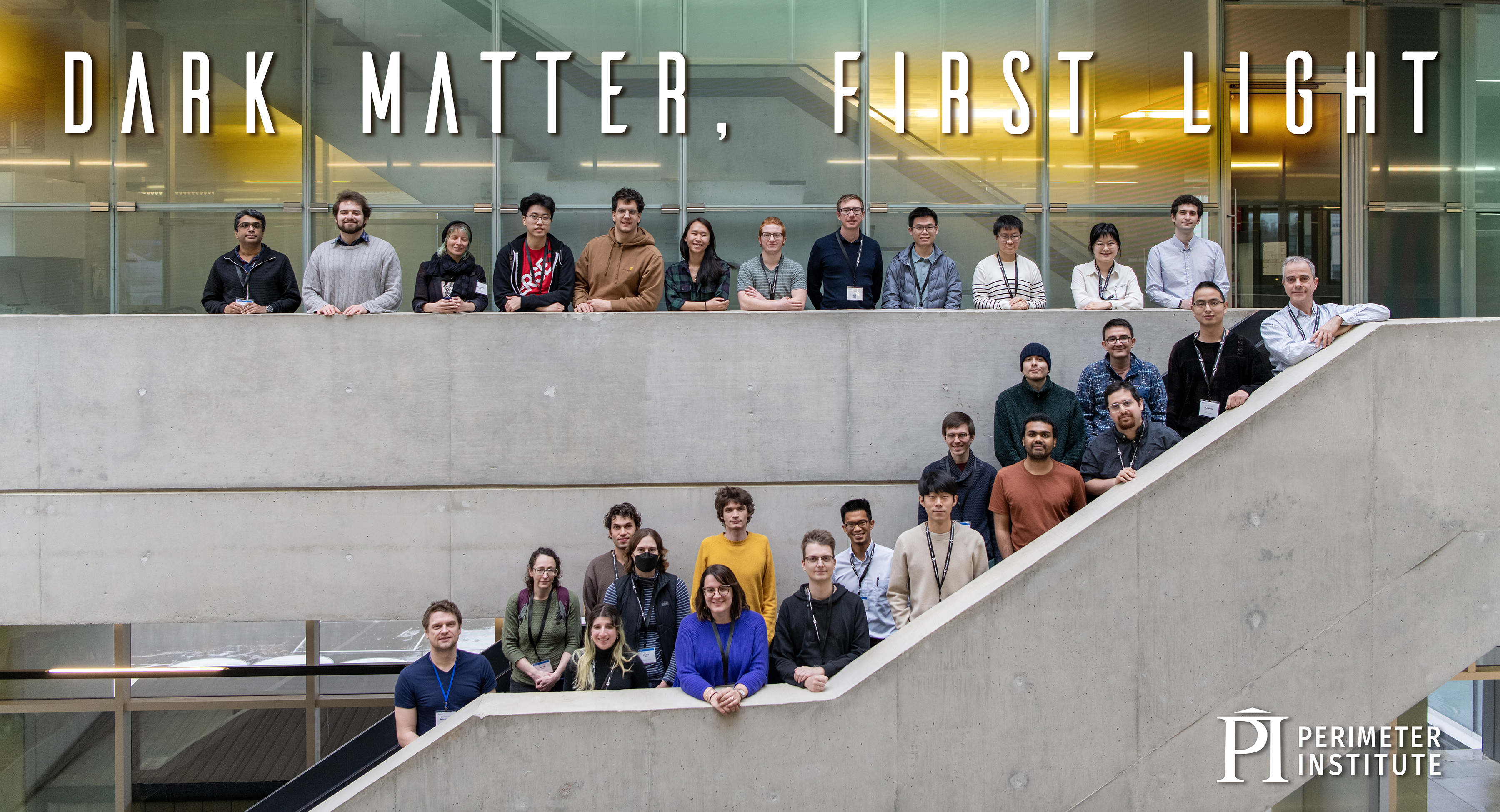
Dark Matter, First Light
New observational programs and techniques are opening a window to the first galaxies in the universe and bringing surprises along the way. In this workshop, we'll explore how dark matter phenomenology may have impacted the first stars and galaxies, focusing on how improved modeling and simulations can allow us to use new and upcoming high-redshift data to gain insight into dark matter's fundamental nature.
Sponsored in part by:
-
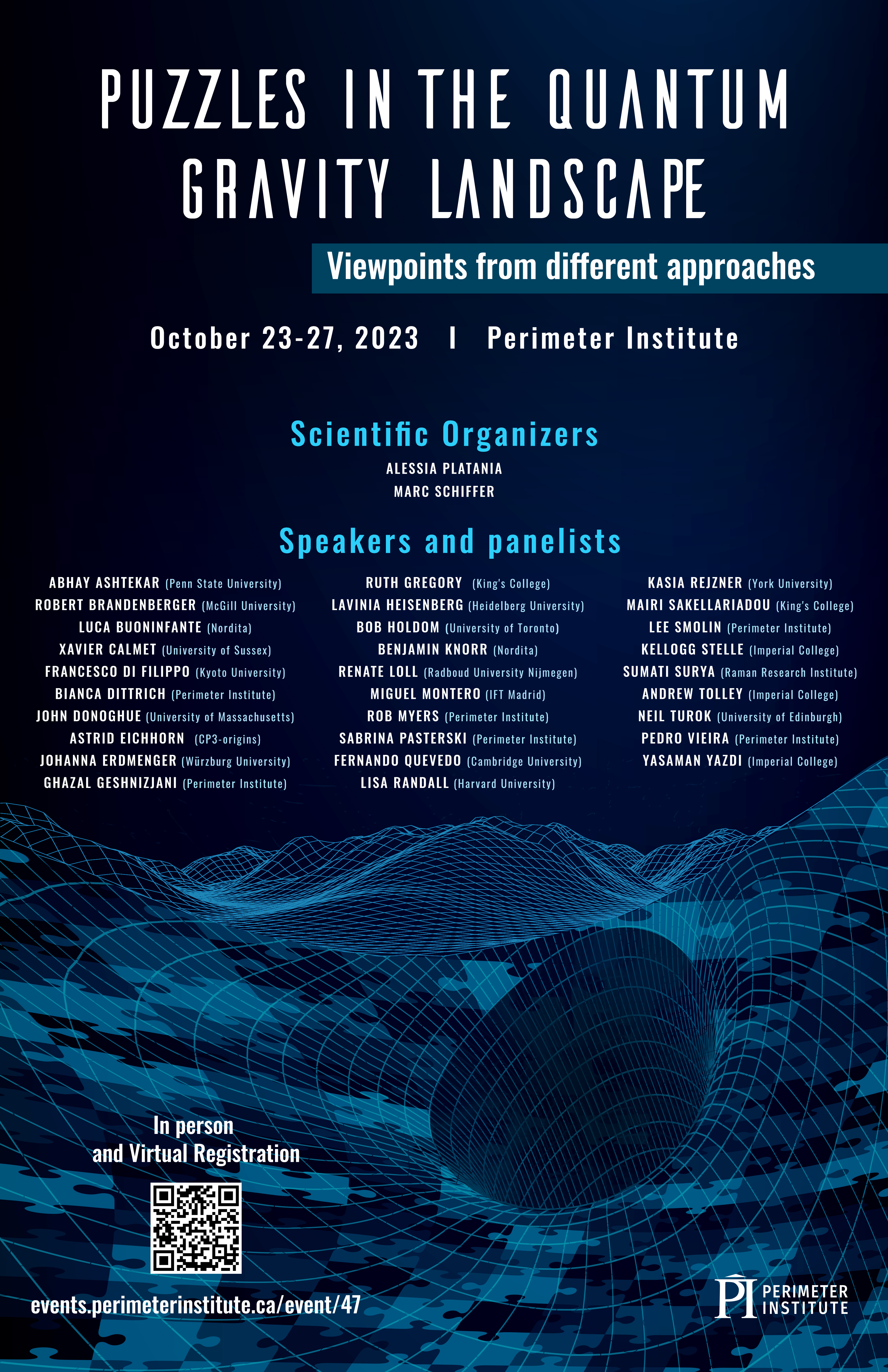
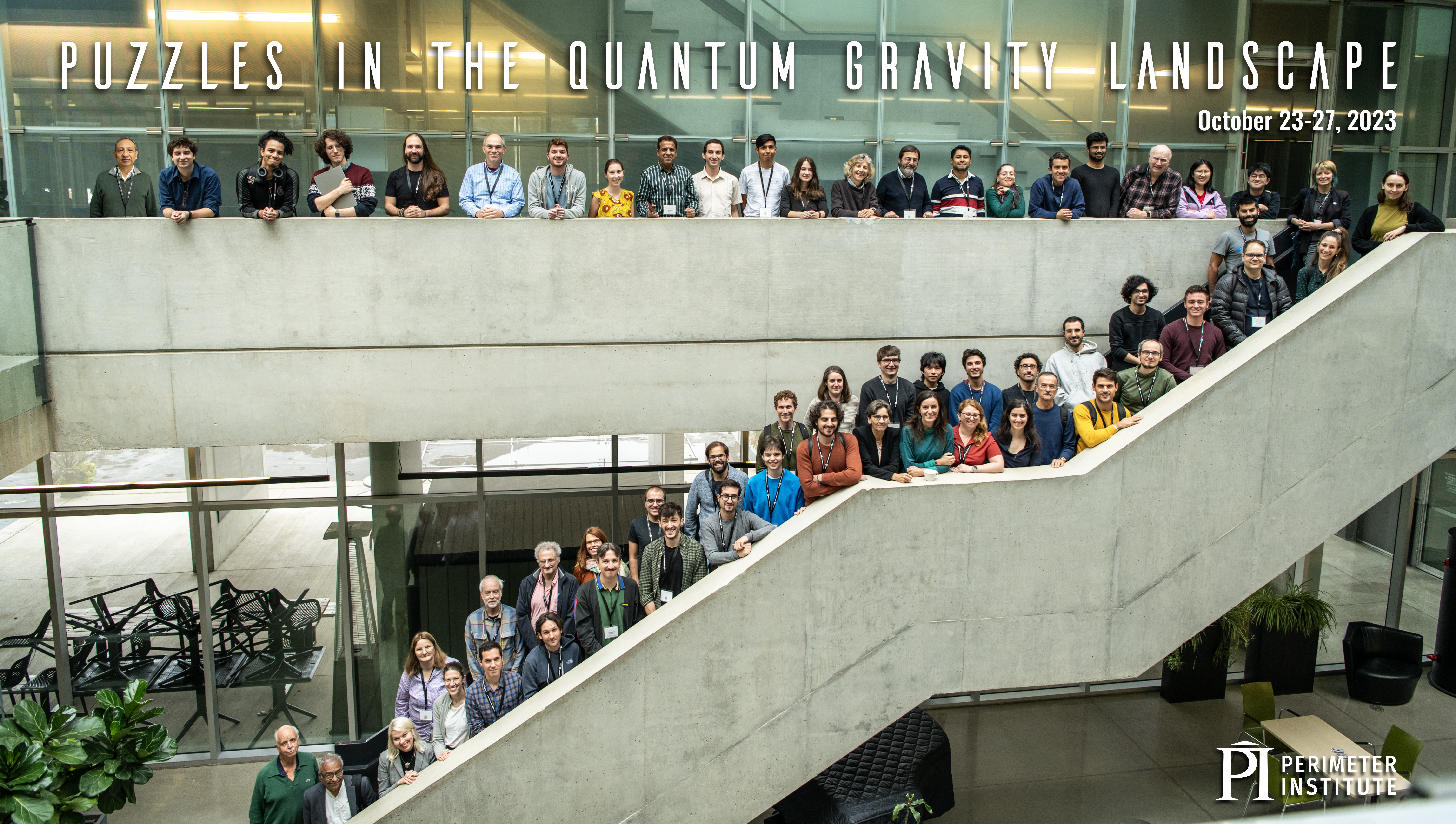
Puzzles in the Quantum Gravity Landscape: viewpoints from different approaches
Unraveling the quantum nature of gravity is one of the most pressing problems of theoretical physics. Several ideas have been put forward and resulted in a number of theories of quantum gravity. While these theories have explored different facets of the “quantum gravity landscape”, all viable approaches should ultimately make contact with observations, and answer exciting questions in cosmology and black-hole physics.
Sharing knowledge, exchanging ideas, and building a dictionary between different theories are crucial steps toward answering these questions, efficiently contrasting different theories, and ultimately reaching a deeper understanding of our Universe.
This conference will contribute to these goals by bringing together leading experts in different approaches to quantum gravity, gravitational effective field theory, black-hole physics, and cosmology. We will focus on specific puzzles in quantum gravity and their resolutions within different approaches. The conference will be highly interactive, with plenty of time to discuss common problems, understand the big picture, and develop novel connections between fields.Registration: Registration is now open, and both in-person and virtual participation is welcome. Online participants will be able to interact on an equal footing in question sessions and discussions. In-person attendance is limited and will be approved on a first-come, first-served basis. Talks are by invitation only, but in-person participants are encouraged to apply to present a poster.
Spam warning: There is an increasing number of scam agencies reaching out to conference speakers and attendees. Perimeter Institute does not use third-party agencies. We advise speakers and attendees to ignore emails and not to provide any details to anyone who is not from Perimeter Institute.
Confirmed Speakers and Panelists:
- Abhay Ashtekar (Penn State University)
- Robert Brandenberger (McGill University)
- Luca Buoninfante (Nordita)
- Xavier Calmet (University of Sussex)
- Francesco di Filippo (Kyoto University)
- Bianca Dittrich (Perimeter Institute)
- John Donoghue (University of Massachusetts)
- Astrid Eichhorn (CP3-origins)
- Johanna Erdmenger (Würzburg University)
- Ghazal Geshnizjani (Perimeter Institute)
- Ruth Gregory (King's College)
- Lavinia Heisenberg (Heidelberg University)
- Bob Holdom (University of Toronto)
- Benjamin Knorr (Nordita)
- Renate Loll (Radboud University Nijmegen)
- Miguel Montero (IFT Madrid)
- Rob Myers (Perimeter Institute)
- Sabrina Pasterski (Perimeter Institute)
- Fernando Quevedo (Cambridge University)
- Lisa Randall (Harvard University)
- Kasia Rejzner (York University)
- Mairi Sakellariadou (King's College)
- Lee Smolin (Perimeter Institute)
- Kellogg Stelle (Imperial College)
- Sumati Surya (Raman Research Institute)
- Andrew Tolley (Imperial College)
- Neil Turok (University of Edinburgh)
- Pedro Vieira (Perimeter Institute)
- Yasaman Yazdi (Imperial College)
Territorial Land Acknowledgement
Perimeter Institute acknowledges that it is situated on the traditional territory of the Anishinaabe, Haudenosaunee, and Neutral peoples.
Perimeter Institute is located on the Haldimand Tract. After the American Revolution, the tract was granted by the British to the Six Nations of the Grand River and the Mississaugas of the Credit First Nation as compensation for their role in the war and for the loss of their traditional lands in upstate New York. Of the 950,000 acres granted to the Haudenosaunee, less than 5 percent remains Six Nations land. Only 6,100 acres remain Mississaugas of the Credit land.
We thank the Anishinaabe, Haudenosaunee, and Neutral peoples for hosting us on their land.
-
Quantum Simulators of Fundamental Physics
This meeting will bring together researchers from the quantum technology, atomic physics, and fundamental physics communities to discuss how quantum simulation can be used to gain new insight into the physics of black holes and the early Universe. The core program of the workshop is intended to deepen collaboration between the UK-based Quantum Simulators for Fundamental Physics (QSimFP; https://www.qsimfp.org) consortium and researchers at Perimeter Institute and neighbouring institutions. The week-long conference will consist of broadly-accessible talks on work within the consortium and work within the broader community of researchers interested in quantum simulation, as well as a poster session and ample time for discussion and collaboration
Territorial Land AcknowledgementPerimeter Institute acknowledges that it is situated on the traditional territory of the Anishinaabe, Haudenosaunee, and Neutral peoples.
Perimeter Institute is located on the Haldimand Tract. After the American Revolution, the tract was granted by the British to the Six Nations of the Grand River and the Mississaugas of the Credit First Nation as compensation for their role in the war and for the loss of their traditional lands in upstate New York. Of the 950,000 acres granted to the Haudenosaunee, less than 5 percent remains Six Nations land. Only 6,100 acres remain Mississaugas of the Credit land.
We thank the Anishinaabe, Haudenosaunee, and Neutral peoples for hosting us on their land.
-
Quantum Spacetime in the Cosmos: From Conception to Reality
On Demand Recording: https://pirsa.org/C23035
The nature of space and time is one of the most foundational mysteries in both Physics and Philosophy. At the heart of this mystery are the two most successful theories of nature: Einstein's theory of relativity, an elegant and precise description of the geometry of our universe on large scales, and Quantum Mechanics, outlining accurate laws of interaction in the subatomic world. But these two great triumphs of 20th century physics remain inherently inconsistent, contradictory in their most basic principles, such as locality and causality. Nonetheless, the experimental domains or natural phenomena where these contradictions become manifest have remained elusive, and it is not clear that a century of theoretical investigation into quantum gravity is anywhere close to being verified in nature.
Arguably, this disconnect is our greatest and most foundational challenge in the history of Physics; despite groundbreaking progress in both theory and observations of quantum spacetimes, these two endeavours are moving farther apart. Successfully responding to this century-old challenge could require rethinking the epistemology of fundamental physics. While physicists are trained to push the frontiers of knowledge, developing a grand vision of the arch of history, and where we are (or should be) heading is a more interdisciplinary endeavor, requiring insights from theory and observations, but also philosophy and history.
We plan a focused, interactive, and highly interdisciplinary workshop, involving the world’s best theorists, observers, experimentalists, and philosophers, within a supportive, inclusive, and diverse environment, in order to kick start a long term initiative that might be our best bet to make significant progress towards uncovering the quantum nature of spacetime.Sponsorship provided by:
Territorial Land AcknowledgemenPerimeter Institute acknowledges that it is situated on the traditional territory of the Anishinaabe, Haudenosaunee, and Neutral peoples.
Perimeter Institute is located on the Haldimand Tract. After the American Revolution, the tract was granted by the British to the Six Nations of the Grand River and the Mississaugas of the Credit First Nation as compensation for their role in the war and for the loss of their traditional lands in upstate New York. Of the 950,000 acres granted to the Haudenosaunee, less than 5 percent remains Six Nations land. Only 6,100 acres remain Mississaugas of the Credit land.
We thank the Anishinaabe, Haudenosaunee, and Neutral peoples for hosting us on their land.